
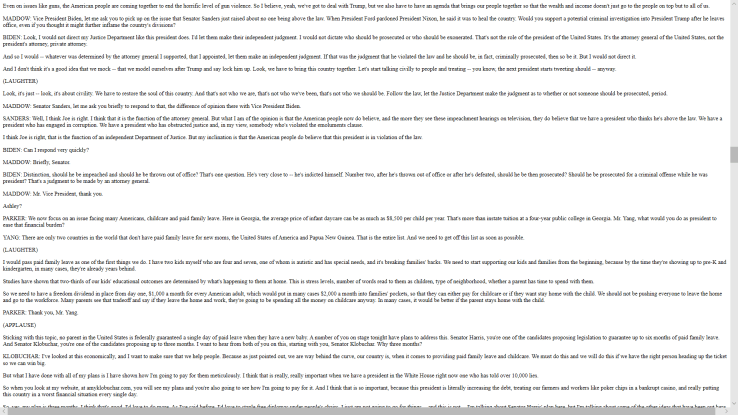
Above is the transcript of the Democratic Party Presidential Debate in November 2019 regarding affordable housing. There are so many problems with the Democratic Party’s approach to this very import and ignored topic that affect potentially millions of Americans of all economic backgrounds. The problem is worst in Democratic Party strongholds, i.e., Los Angeles, San Francisco, Oakland, Seattle, Portland, the entire California coastline, Washington D.C, New York, Boston, and Minneapolis.[i] Only one questions was posed to the candidates and only 3 candidates were allowed to respond. Clearly its not an important issue to the Democratic Party leadership.
The Black communities have been and are currently being targeted and relocated. Every city listed above has also relocated most of its Black populations including some of the most culturally important and sacred neighborhoods such Harlem, the Central District in Seattle, the Fillmore District in San Francisco, Oakland, Adams Historical district in Los Angeles, Washington D.C., and soon in Los Angeles the areas of Inglewood, Crenshaw, and what few remaining of metro Los Angeles that are left with any affordable housing. The general approach is not acceptable for our communities and will not help us. In addition the homeless effect on our population is extreme and disproportionate to our population numbers. Blacks comprise of approximately 38% of the homeless population in Los Angeles County yet are no more than 11% of the population. [ii] Adult Black persons in homelessness increased +11% last year. [iii] The 2019 Greater Los Angeles Homeless County reports a 16% increase in Los Angeles City. [iv] However, the number quoted of 16% increase in the homeless population in Los Angeles is misleading in that the number is higher in most of the central districts (CDs). The 16% number is an average of the CDs with most CDs reporting increases up to 20+%. Homeless people and those in transition are less likely to vote. The effect is mass and unreported disenfranchisement based on economics and race. Further Black relocation from a condensed urban core to a widespread multi-county population guarantees a reduction in Black voting power, especially at the local and state levels. (see posts)
Sen. Warren’s answer is ridiculous, is a perfect example of the answer given by whites who benefit from the housing markets and claim they like Blacks, and is full of material omissions meant for people to rely upon, and upon which people do rely upon, and these omissions result in damages to Black communities who are facing relocation and exploitation. These are Sen. Warren’s initial responses, making them a good measure of how she really feels and her ideas on the topic. They are not going to help us or the middle class. Sen. Booker’s and Steyer’s answers were adequate but not complete by themselves. Steyer correctly framed the issue in part- the need to open up communities that have resisted new housing units and the need to provide “federal dollars to make sure the units are affordable so that working people can live in places and not pay 50% of their income on rent.” The accepted racist and misguided approach is trying to make Black neighborhoods provide the affordable housing units (either by overwhelming amounts of people taking advantage of the intentionally depressed housing market or by policy requiring affordable housing units be built along high transit lines which happen to be predominantly in Black neighborhoods and lets the actual offending peoples to keep their ill gained housing property values and be exempt from any requirements to provide affordable housing units). Please see my prior posts. However, he neglects to address the need for people to be able to buy into these cities and realize the dream of home ownership with a yard, and the significant racial component. Booker also provided a good answer, but I am advocating against the use of the word “gentrification”. (post link). People do not become aristocracy just for taking advantage of an area’s economic woes and relocating the population. It is such a pathetic, self-promoting, racist word that the offenders picked for themselves. Blacks should never help them with that characterization. However, Sen. Booker was the only candidate who addressed not only the racial issues but also the resulting relocation. Sen. Booker’s suggestion of subsidizing renters is right on for renters. I would like to see more ideas regarding ensuring people can still buy into these areas with affordable housing issues and ways to increase Black and/or middle class homeownership which is not going to happen with the state of the housing market in our communities and others. All candidates need to address the desire and dream of single-family-dwelling ownership in these cities that was a such a large part of America’s economic expansion after WWII for whites. As of now, all answers will allow for the unfair result of those who drove up the costs being able to keep their homes and curtilage while everyone else is piled on top each other in mass housing units of apartments, condos or projects.
Below I address in detail Sen. Warren’s arguments:
WARREN: Yes. Think of it this way. Our housing problem in America is a problem on the supply side, and that means that the federal government stopped building new housing a long time ago, affordable housing.
• Warren completely blames the federal government and developers (see next line) which is an untruth. The role of people flooding into the urban cores or the coastal communities who then drive up the rents and housing costs, which always results in mass displacement, increased general homelessness and economic shut-out, cannot be ignored. The racial implications for Blacks are immense and this pattern has only fueled white supremacy under the guise of secret racism. Please see my earlier posts.
WARREN: Also, private developers, they’ve gone up to McMansions. They’re not building the little two bedroom, one bath house that I grew up in, garage converted to be a bedroom for my three brothers.
• Again Warren blames everyone but herself, her neighbors and other like them who just happen to benefit in the millions from this housing market crises. In my personal observations, its individuals who buy small lots for too little and then build these monstrosities called McMansions which completely destroy the character of the area. The big developers build units of hundreds. Together they push people out.
• This is just blatant pandering that, as a Black who grew in standard 2-story, 4 bedroom, 2.5 baths with a pool, I don’t relate to. Its funny in the context of her expensive house that even white people she grew up with couldn’t live there.
WARREN: So I’ve got a plan for 3.2 million new housing units in America. Those are housing units for working families, for the working poor, for seniors who want to age in place, for people with disabilities, for people who are coming back from being incarcerated. It’s about tenant’s rights.
• One would expect help for the middle class but apparently not. Sen. Warren names every marginalized group besides the middle class, working individuals without families, students and the upper middle class to name a few. The middle class are neglected in these discussions. The extreme housing costs requires a plan that includes assistance for those who have jobs, decent income, etc., and not just for the poor or working poor.
• Sen. Warren completely misrepresents the scope of the issue. Affordable housing is not a poverty issue or a marginalized group issue. Middle class and upper middle-class people cannot afford to buy property in numerous major metropolitan cities. Most people in this country cannot afford to buy into Sen. Warren’s neighborhood in Cambridge, MA. Most people cannot afford million-dollar home price tags. This economic shut out is in effect in many cities. In addition, people may want more than a small dwelling or a condo. A front-yard or backyard should not be only for millionaires. Both Black and White Americans have been displaced and shut out of all future purchases in these areas (unless there is an economic downturn in the housing market). Many have had to leave states like California for work and housing. Her omissions combined with her own $2.5 million dollar gain in her private housing property values in Cambridge, MA due to replacement and exploitation of property values, strongly suggest she has an interest in keeping the true scope of the housing problem a secret and does not plan on addressing the real housing problem in the country that is affecting Americans of all the economic backgrounds, especially the middle class and upper middle class. Although she grew up poor, now she doesn’t see too many poor people. Living in Cambridge, she has benefited in the millions from poor and middle-class whites being pushed out of the housing market. Neither her husbands’ nor her students can live in her neighborhood. “Mann and Warren have also gotten richer just by living in Cambridge, home of Harvard and one of the hottest real estate markets in Massachusetts. They bought their house in 1995 for $447,000. Today, Forbes estimates it’s worth $3 million.”.[v] Even if her she didn’t make as much money as reported she still materially mischaracterizes the problem.
• Sen Warren is basically stating projects are her answer- federal built housing is a project.
• Sen. Warren does not specify where these projects will be built- will they b in the cities where housing is completely out of reach for most people, such as her own home city of Cambridge, or will they actually be in the city limits. As of now, in major cities such as Los Angeles, Boston, Seattle, and New York (Manhattan), there are NO available homes for $200,000.[vi] The cheapest home was sold for $500,000 in San Francisco. These are all Democratic Party strongholds suggesting that “affordable housing” is actually a Democratic Party problem. I can get a very nice home for $200,00 in the south and mid-west.[vii]
WARREN: But there’s one more piece. Housing is how we build wealth in America. The federal government subsided the purchase of housing for decades for white people and has said for black people you are cut out of the deal. That’s was known as red-lining.
• Yes, housing is one way to build wealth in America. However, unless one has millions of dollars to spend on a house, one will not be building wealth near Sen. Warren and others who live in these areas.
• Blacks are facing relocation due to extreme housing costs. Her neighborhood and others like Cambridge is off limits to most Blacks in this country and is a perfect example of how high the prices ALWAYS get. This is how secret racism works- no official “red-lining”; just Black disappearing due financial, social or whatever reasons. According to statistics, Native American can’t live near her either or build their wealth in her neighborhood.
[i] Natalie Hopskinson “Farewell, Chocolate City”, New York Times, June 3, 2012; Maura Dolan, “San Francisco’s Black Population Dwindling”, The Seattle Times, May 11, 2015, http://www.seattletimes.com/nation-world/san-franciscos-black-population-dwindling/; Nadre Nittle, “Will San Francisco’s Black Population Vanish as City’s Wealth Rises?”, Atlanta Black Star, October 13, 2015, http://atlantablackstar.com/2015/10/13/will-san-franciscos-black-population-vanish-citys-wealth-rises/; Jaithe Har, “San Francisco’s Housing Shortage Threatens African Americans”, Seattle Times, December 28, 2015, http://www.seattletimes.com/nation-world/san-franciscos-housing-shortage-threatens-african-americans; Thomas Fuller, “The Loneliness of Being Black in San Francisco”, New York Times, July 20, 2016, https://www.nytimes.com/2016/07/21/us/black-exodus-from-san-francisco.html; Sam Roberts, “White Population Rises in Manhattan”, New York Times, July 4, 2010. https://cityroom.blogs.nytimes.com/2010/07/04/white-population-rises-in-manhattan/; Sam Roberts, “No Longer Majority Black, Harlem in in Transition”, New York Times, January 5, 2010, http://www.nytimes.com/2010/01/06/nyregion/06harlem.html; Tyrone Beason, “Seattle’s Vanishing Black Community”, Seattle Times, Pacific NW Magazine, May 26, 2016, https://www.seattletimes.com/pacific-nw-magazine/seattles-vanishing-black-community/; Gene Balk, “Historically Black Central District Could Be Less Than 10% Black In a Decade”, Seattle Times, May 25, 2015, https://www.seattletimes.com/seattle-news/data/historically-black-central-district-could-be-less-than-10-black-in-a-decade/; Andrew Theen, “Portland Area Attracting New and Diverse Residents as Black Population Dwindles”, Oregonian, March 8, 2017, http://www.oregonlive.com/portland/index.ssf/2017/03/post_585.html; See also Balk, “As Seattle Gets Richer, the City’s Black Households Get Poorer”.
[ii] Benjamin Oreskes, Doug Smith, “Homelessness jumps 12% in L.A. County and 16% in the city; official ‘stunned'”, Los Angeles Times, June 4, 2019, https://www.latimes.com/local/lanow/la-me-ln-homeless-count-encampment-affordable-housing-2019-results-20190604-story.html; 2019 Greater Los Angeles Homeless Count- City of Los Angeles, Los Angeles Homeless Service Authority, https://www.lahsa.org/documents?id=3421-2019-greater-los-angeles-homeless-count-city-of-los-angeles.pdf. 38% Black/African American: Prevalence in 18 and over Homeless population (%), +11%: Percent Change 2018-2019, 4716 sheltered, 8913 unsheltered. see also https://www.lahsa.org/news?article=557-2019-greater-los-angeles-homeless-count-results&ref=hc
[iii] Ibid.
[iv] Ibid.
[v] Michela, Tindera, “How Elizabeth Warren Built A $12 Million Fortune,” Forbes, August 20, 2019, https://www.forbes.com/sites/michelatindera/2019/08/20/how-elizabeth-warren-built-a-12-million-fortune/#6f29bccbab57
[vi] Frank Olito, “Here’s what $200,00 will get you in real estate in 20 US cities.” Business Insider, https://www.msn.com/en-us/money/realestate/heres-what-dollar200000-will-get-you-in-real-estate-in-20-us-cities/ss-BBYaFtg?ocid=spartanntp#interstitial=3, last accessed December 29, 2019.
[vii] “Here’s what $200,000 will get you in real estate in 20 US cities.”

 Essays on Modern Jim Crow and Black Relocation From the Urban Cores; Inglewood, CA is Great with Blacks