
The NFL Players’ Kneeling During The National Anthem Is Steeped In American Historical and Political Tradition and Echoes Frederick Douglass’ Famous Reading of “Oration” During a Fourth Of July Meeting In 1852.
“…we do ask, in the name of all that is just and magnanimous among men, to be freed from all the unnatural burdens and impediments with which American customs and American legislation have hindered our progress and improvement. We ask to be disencumbered of the load of popular reproach heaped upon us — for no better cause than that we wear the complexion given us by our God and our Creator.” (Frederick Douglass, J.M. Whitfield, H.O Wagoner, Rev. A. N. Freeman, George B. Vashon; “Claims of our Common Cause: Address of the Colored Convention held in Rochester, July 6-8, 1853, to the People of the United States”; Proceedings of the Colored National Convention Held in Rochester, July 6th, 7th and 8th, 1853.)
“What, to the American slave, is your 4th of July? I answer; a day that reveals to him, more than all other days in the year, the gross injustice and cruelty to which he is the constant victim.” (Frederick Douglass; “Oration”; Fourth of July Meeting held in Rochester, July 5, 1852.)[i]
On May 23, 2018 the NFL owners approved a national anthem policy for 2018, voting to censure and suppress rightful first amendment speech by forcing the players to protest in silence and away from the public forum.[ii] Out of sight; out of mind – with the hope that the players’ message will be ignored, forgotten and disappear. The NFL players’ kneeling during the national anthem is steeped in strong historical and political precedence which squarely places their protest within American tradition and patriotism. The players’ addressed modern problems with a modern message on a modern stage. But their actions are completely analogous to Frederick Douglass’ celebrated and famous reading of his discourse “Oration”, addressing the meaning of the Fourth of July to the American Negro, during a 4th of July meeting in 1852. The NFL players’ kneeling and Mr. Douglass’ Oration have the following similarities: (1) context within national celebrations of the American Revolution and its principals; (2) actions of free speech expressing dissent and protest done with respect for the Country; (3) messages protesting “gross injustice and cruelty to which he [American Negro/ Black] is a constant victim” including police brutality, inequalities in laws, education and economic opportunities; and (4) forum of a public stage for the purposes of bringing the message to the greater public in order to foster national discussion and action.
Oration.


Frederick Douglass “ORATION” title page and excerpt, delivered July 5, 1852, Lee, Mann & Co.: Rochester, NY, 1852. Full text[PDF Douglass_Fifth_of_July_Speech(9)]
On July 5, 1852 Frederick Douglass spoke before abolitionists in Rochester, New York at a Fourth of July meeting celebrating the national anniversary.[iii] His discourse is entitled Oration[iv] and is an unflinching and eloquent protest of American institutional racism and slavery. His topic is the meaning of the 4th of July to the American Negro. He did not take the traditional flag-waving approach when speaking about July 4th.
“Fellow-citizens, pardon me, allow me to ask, why am I called upon to speak here to-day? What have I, or those I represent, to do with your national independence? Are the great principles of political freedom and of natural justice, embodied in that Declaration of Independence, extended to us?”
The answer is NO.
Instead he spoke on the national inconsistencies which allows for American Negros, free or slave, to endure horrific and constant injustices, inequality in laws and in education, cruelty, brutality, scorn, murder, kidnapping, slave trade, disenfranchisement from both the vote and right to bear arms, economic injustices, and suppression of any public discourse of the many wrongs, while the nation celebrates the principles enshrined in the Declaration of Independence including political freedom, pursuit of happiness/prosperity, equality and natural justice.[v] He refuses to be silent and his refusal to be silent is a crucial part of his protest. On July 4th and any other day,
“in regard to the ten thousand wrongs of the American slave, you would enforce the strictest silence, and would hail him as an enemy of the nation who dares to make those wrongs the subject of public discourse!”
In Oration, Frederick Douglass explains the reasons why he cannot and will not as an American freeman or speaking for the American slave celebrate July 4th in silence without exercising his right to free speech as a citizen of the United States regarding the hypocrisy and injustices heaped upon Blacks, even if silence is the customary practice.
“Fellow-citizens, above your national, tumultuous joy, I hear the mournful wail of millions!”
If Blacks were treated better, Mr. Douglass would happily celebrate the Fourth with all the joy, revelry and prayer as the whites. However the racial disparity and its resulting pain and injustices prevents his silence on this day, stating
“But such is not the state of the case. I say it with a sad sense of the disparity between us. I am not included within the pale of this glorious anniversary! Your high independence only reveals the immeasurable distance between us. The blessings in which you, this day, rejoice, are not enjoyed in common.-The rich inheritance of justice, liberty, prosperity and independence, bequeathed by your fathers, is shared by you, not by me. The sunlight that brought light and healing to you, has brought stripes and death to me. This Fourth of July is yours, not mine. You may rejoice, I must mourn.”
In other words, July 4th celebrated rights that belonged only to whites and not to Black Americans who were violently and legally excluded from participating in exercising these very same rights, who were hated by American society, and for most, who were still in slavery. As such, he could not and would not stay silent. Mr. Douglass stated that the time for arguing Blacks’ humanity, entitlement to liberty and citizenship had passed; that the time for debating slavery had passed; and that the time is for action!
Indeed, it is because of these principals of justice, liberty, prosperity and independence, that Mr. Douglass needed to speak. The rights and liberties which Blacks and whites fought for against British tyranny required eradication of the injustices heaped upon Blacks to remain effective and real governing principals. The bombast, fraud, deception, impiety, and hypocrisy resulting from slavery and American racism was destroying these principals. Thus, he was speaking to protect these American ideals- is that not patriotism?
It is also because of these principles’ messages of equality, political freedom, liberty, pursuit of happiness/prosperity, and natural justice that the injustices committed against Blacks by American customs and legislation are so offensive when compared against each other.
Police Brutality/ The Fugitive Slave Law of 1850.
The reality forced upon Mr. Douglass by the Fugitive Slave Law of 1850 made it impossible for him and for all other Blacks in America, free or slave, to pretend even for a day that the great principles of liberty, equality and justice belonged to them, and as such, made it impossible to celebrate the Fourth of July in silence. The 1850 Fugitive Slave Law criminalized aid to any Black who was accused of being an ex-slave, bribed judges to send Blacks to slavery, and forbade Blacks from speaking in their own defense before the Court. A Black would be condemned to slavery based only on the testimony of two whites without any right to bring witnesses on his or her behalf. The Fugitive Slave Law of 1850 nationalized and made it a crime not to enforce the Fugitive Slave Act of 1793 which allowed slave hunters and kidnappers to forcibly bring Blacks to slavery anywhere within the United States and its territories.[vi] Congress passed the 1850 Fugitive Slave Law, meaning both the North and the South aligned to destroy free Black existence here using the legal system, its powers and its agents.
“But a still more inhuman, disgraceful, and scandalous state of things remains to be presented. By an act of the American Congress, …, slavery has been nationalized in its most horrible and revolting form. By that act, … the power to hold, hunt, and sell men, women and children, as slaves, remains no longer a mere state institution, but is now an institution of the whole United States. The power is co-extensive with the star-spangled banner, and American Christianity. Where these go, may also go the merciless slave-hunter. … For black men there is neither law nor justice, humanity nor religion. The Fugitive Slave Law makes mercy to them a crime; and bribes the judge who tries them. An American judge gets ten dollars for every victim he consigns to slavery, and five, when he fails to do so. The oath of any two villains is sufficient, … to send the most pious and exemplary black man into the remorseless jaws of slavery! His own testimony is nothing. He can bring no witnesses for himself. … Let it be thundered around the world that in tyrant-killing, king-hating, people-loving, democratic, Christian America the seats of justice are filled with judges who hold their offices under an open and palpable bribe, and are bound, in deciding the case of a man’s liberty, to hear only his accusers! …
“At the very moment that they are thanking God for the enjoyment of civil and religious liberty, and for the right to worship God according to the dictates of their own consciences, they are utterly silent in respect to a law which robs religion of its chief significance and makes it utterly worthless to a world lying in wickedness.”
To enforce the 1850 Fugitive Slave Law, the government authorized the police to hunt and capture Blacks, free or ex-slave and conscript them to slavery. Sadly, Blacks could not even report crimes or seek help from the police.
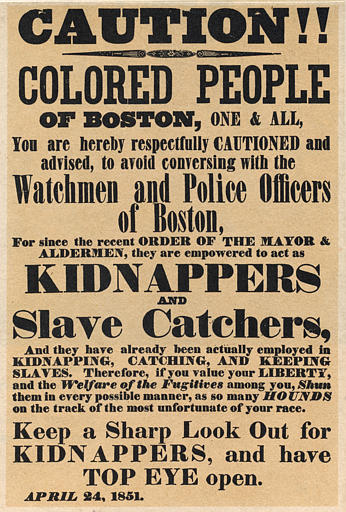
Everyday people attempted to capture them.[vii] Mr. Douglass graphically details the horror, the brutality, both emotional and physical, and the economic incentives and gains of the internal slave trade and capture business[viii]. The 1850 Fugitive Slave Law increased the economic gains from the apparatus created by the internal slave trade and business of kidnapping Blacks. Similarly, today, the thriving prison system business makes others money off the backs of police arrests/brutality and the criminal justice system.


As in 1850, Blacks today endure constant police brutality and live in fear of this brutality and of incarceration. Almost every day there is another account of a Black being killed by the police or beaten, abused or embarrassed from around the country. Video continues to capture Black men being murdered and nothing is stopping their deaths. As in 1850, American legislation and society ratified the police power to hunt, arrest, maim and kill Blacks. That power today is also “an institution of the United States” and “is co-extensive with the star-spangled banner”. Where the police may go enforcing US law, so does police brutality. In New York and California, the police are being used to remove Blacks so that the new urbanites can move in without getting their hands dirty.[ix] (See my post re police brutality and relocation.[x]) This realty, as in 1850, makes it impossible for Blacks today to silently sit and pretend all enjoy equality. The situation’s gravity cannot be understated. We are tired of dying and facing relocation in an uncaring and hostile country. Over 160 years later Blacks confront the same issues.
(scroll down for next page button)

 Essays on Modern Jim Crow and Black Relocation From the Urban Cores; Inglewood, CA is Great with Blacks